
Ethical AI & Secure SDLC: A Leader’s Guide to Building Trust
A strategic framework for embedding responsibility into every stage of AI development.
Artificial Intelligence is now a core business capability rather than a futuristic concept. As AI moves deeper into products, workflows, and decisions, leaders face a crucial question: are we building systems that are not only powerful, but also trustworthy? The answer lies in combining Ethical AI with a Secure Software Development Lifecycle (SSDLC).
The Rising Imperative for Ethical and Secure AI Development
Rapid AI adoption has been accompanied by high-profile incidents of biased algorithms, AI-driven security breaches, and opaque decision-making. These are no longer niche technical issues; they are boardroom-level risks that affect brand reputation, regulatory exposure, and long-term business resilience.
Understanding and implementing ethical and secure AI practices is no longer optional—it is foundational to sustainable success, customer trust, and compliance in an evolving AI regulatory landscape.
Understanding the Foundations: Ethical AI & Secure SDLC
A. What Is Ethical AI? (Beyond the Buzzword)
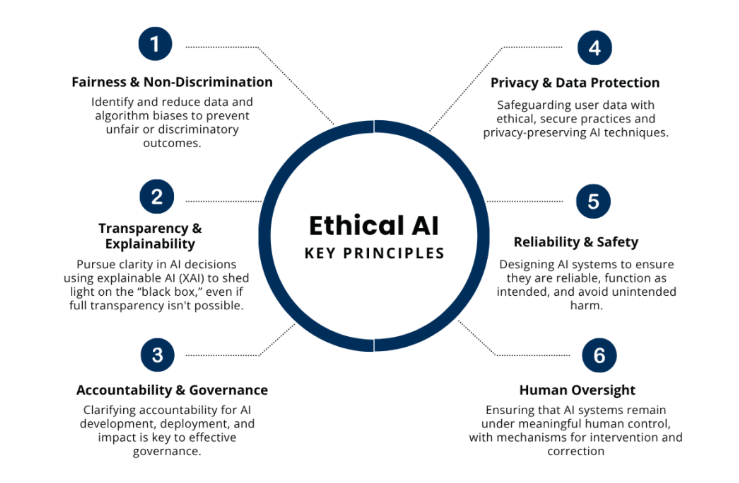
Ethical AI refers to the development and deployment of AI systems in a way that aligns with human values and moral principles. It is about ensuring that AI benefits humanity and minimizes harm, particularly for the people and communities impacted by its decisions.
For business leaders, these principles translate directly into enhanced customer trust, a stronger brand, and proactive AI risk management that reduces the chances of regulatory or reputational shocks.
B. What Is Secure SDLC (SSDLC)? (Building Security In, Not Bolting It On)
A Secure Software Development Lifecycle (SSDLC) embeds security into every stage of software creation—from requirements and design through development, testing, deployment, and ongoing maintenance. Instead of “bolting on” security at the end, teams design for security from day one.
For technology leaders, implementing SSDLC practices for AI and ML systems means building more robust applications, reducing the likelihood of costly breaches, and fostering a culture of security awareness across engineering teams. It is a core pillar of DevSecOps for AI/ML pipelines.
The Crucial Intersection: Why Ethical AI Needs a Secure SDLC
Security as a Prerequisite for Ethics
How can an AI system be considered fair if its training data has been maliciously tampered with due to a security lapse (data poisoning)?
How can AI respect user privacy if it is vulnerable to data breaches that expose sensitive information?
Adversarial attacks—such as model evasion (tricking a model into misclassifying inputs) or model inversion (extracting sensitive training data)—are security threats with profound ethical consequences.
Ensuring AI model integrity and security is therefore a prerequisite for any ethical AI initiative.
Ethical Considerations for Security Measures
Security measures themselves must also be ethically sound. For example, an AI-powered surveillance system designed for safety could, if poorly governed, infringe on privacy or be used in discriminatory ways. Balancing protection with rights and freedoms is central to responsible AI security design.
Building Holistic Trust
Customers and stakeholders rarely distinguish between an ethical lapse and a security failure when their trust is broken. A system that makes biased decisions is untrustworthy; a system that leaks data is equally untrustworthy.
Integrating ethical considerations into a secure AI development lifecycle ensures that you address trust from all angles. This holistic approach influences brand loyalty, regulatory posture, and long-term market position.
00
The “Why”: Tangible Benefits of Integrating Ethical AI and SSDLC
For Business Leaders
Enhanced brand reputation & loyalty. Responsible AI practices build deeper, more durable trust with customers and partners.
Reduced regulatory and legal risk. Proactive AI risk management can prevent costly fines (e.g., GDPR, emerging AI acts) and reputational damage.
Competitive differentiation & innovation.. Secure, ethically sound AI is adopted faster and opens new market opportunities.
Improved investor confidence. Investors increasingly scrutinize the ethical and security posture of AI-driven businesses.
Attracting & retaining talent. Top engineers and data scientists want to work on systems that are both technically advanced and socially responsible.
For Tech Leaders
More robust, resilient AI systems. Security and ethics from the outset lead to higher-quality, dependable AI solutions.
Reduced rework and lower costs. Fixing ethical or security flaws post-deployment is significantly more expensive than addressing them early.
Streamlined compliance & auditing. Structured processes make it easier to demonstrate due diligence and meet evolving AI compliance requirements.
Clear guardrails for development. Engineering teams benefit from explicit principles and processes, reducing ambiguity and misalignment.
Future-proofing. Building with ethics and security in mind helps organizations adapt to new threats, societal expectations, and AI regulations.
00
The “How”: A Practical Framework for Implementation
A. Foundational Steps
Leadership buy-in & vision. CEOs and senior leaders must champion Ethical AI and SSDLC, allocate resources, and set the cultural tone.
Cross-functional teams. Bring together legal, ethics, security, product, data science, and engineering. AI governance is a team sport.
Define your Ethical AI principles. Tailor global principles to your industry and context. Clarify what “fairness” and “harm” mean for your AI applications.
Establish governance structures. Implement AI ethics boards or review processes with clear roles, responsibilities, and accountability across the AI lifecycle.
B. Integrating Ethical AI into the SSDLC (Phase-by-Phase)
Requirements & Planning
Ethical AI focus: Conduct ethical risk and bias impact assessments; define fairness metrics and explicit data privacy requirements.
SSDLC focus: Begin threat modeling for AI systems, considering AI-specific vulnerabilities and attack surfaces.
Design & Architecture
Ethical AI focus: Apply Privacy-by-Design, design for explainability (XAI), and practice data minimization.
SSDLC focus: Architect secure data handling (at rest, in transit, in use), model protection, and robust access controls. Refine threat models early.
Development
Ethical AI focus: Use bias detection and mitigation techniques, ensure data provenance and lineage, and document assumptions behind model behavior.
SSDLC focus: Enforce secure coding standards for AI/ML components, use vetted libraries, implement secure APIs, and secure AI data pipelines end to end.
Testing & Validation
Ethical AI focus: Run fairness tests, robustness checks, and AI ethics evaluations; validate explainability mechanisms with real stakeholders.
SSDLC focus: Perform AI-specific security testing, penetration tests, vulnerability scanning for AI frameworks, and fuzz testing where applicable.
Deployment & Operations
Ethical AI focus: Continuously monitor for model drift, performance degradation, and the emergence of new biases in production.
SSDLC focus: Implement secure deployment configurations and monitoring. Maintain an incident response plan for both security breaches and ethical failures.
Maintenance & Decommissioning
Ethical AI focus: Address ethical considerations when updating or retiring models, including data retention and deletion policies.
SSDLC focus: Manage model updates and patches securely, and ensure secure decommissioning of systems and associated data.
C. Essential Tools & Techniques
Organizations can leverage AI fairness toolkits (e.g., IBM AIF360, Google’s What-If Tool, Fairlearn), explainability libraries (LIME, SHAP), security scanning tools, static and dynamic analysis (SAST/DAST), and threat modeling frameworks such as STRIDE or PASTA to operationalize Ethical AI and SSDLC practices.
00
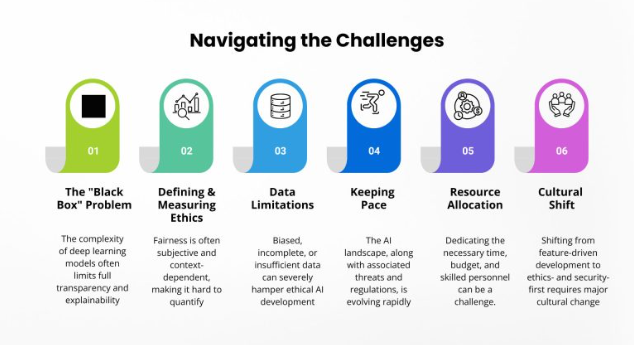
Navigating the Challenges
Implementing a comprehensive Ethical AI and Secure SDLC framework is not trivial. It requires new skills, cross-functional collaboration, and a willingness to challenge existing delivery habits.
Acknowledging these challenges is the first step. The key is to adopt an iterative approach: start with the most critical systems and risks, build early wins, and continuously improve your governance, tooling, and culture.
00
The Future Is Ethical and Secure
Growing regulatory landscape. Governments are introducing AI-specific regulations (e.g., the EU AI Act, Canada’s AIDA) that mandate ethical and secure practices.
Rising customer and societal expectations. Users increasingly expect AI systems to be fair, transparent, and protective of their data.
AI for good—and for security. AI itself can enhance security monitoring, detect bias, and strengthen ethical oversight.
Evolution of best practices. Frameworks, tools, and methodologies for Ethical AI and AI security are rapidly maturing.
The organizations that act now will not only comply with future mandates—they will lead in building a more equitable, secure AI-powered future.
00
Conclusion: Your Blueprint for Responsible Innovation
Integrating Ethical AI principles within a Secure Software Development Lifecycle is now a cornerstone of responsible innovation and sustainable business success. It is how leaders build AI that is not only intelligent and efficient, but also fair, transparent, secure, and trustworthy.
Rather than viewing ethics and security as compliance burdens or cost centers, treat them as strategic enablers that strengthen resilience, foster customer loyalty, and unlock new growth opportunities.
Start the conversation inside your organization today. Assess your current AI development practices against these principles and identify the first, concrete steps you can take to embed ethics and security into the DNA of your AI initiatives.
The journey to truly trustworthy AI begins with a simple commitment: build it right, right from the start.
At V2Solutions, we architect intelligent, scalable systems powered by AI—from blueprint to brilliance. Let’s design the future—together. Connect with us to schedule a consultation.
Ready to Build Trustworthy, Secure AI?
Connect with us to explore your unique challenges and design an Ethical AI & Secure SDLC roadmap tailored to your organization.
Author’s Profile