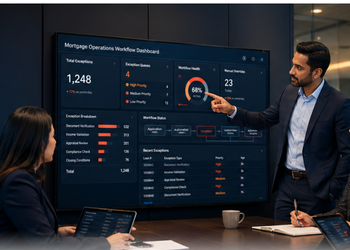

Mortgage Workflow Automation: Why Automation Creates More Exceptions Than It Eliminates
Mortgage Workflow Automation: Why Automation Creates More Exceptions Than It Eliminates The Exception Problem Hiding Inside Your Mortgage Automation ROI — And How to Fix It. Most mortgage workflow automation programs generate more exceptions than they resolve because they’re built on fragmented LOS infrastructure without adequate process architecture, edge-case mapping, or governance. The efficiency gains
May 14, 2026-
The Multi-Agent Enterprise: How Collaborative AI Is Redefining Autonomous IT Support
The Multi-Agent Enterprise: How Collaborative AI Is Redefining Autonomous IT Support How collaborative AI agents are enabling autonomous, outcome-driven IT support at enterprise scale. What happens when AI stops acting like a standalone assistant and starts functioning like an entire operations team? For more than a decade, CIOs have chased the same ambition: an IT
May 14, 2026 -
Why Your Master Data Is the Real Source of AI Hallucinations
Why Your Master Data Is the Real Source of AI Hallucinations The hidden enterprise data problem quietly undermining AI trust, accuracy, and scale AI hallucinations are usually blamed on models. When copilots generate incorrect responses, agents make flawed recommendations, or RAG systems surface misleading information, the instinctive reaction is to question the LLM, the prompt
May 13, 2026 -
Building an AI-Ready Master Data Foundation: From Golden Records to Governed Context
Building an AI-Ready Master Data Foundation: From Golden Records to Governed Context The data infrastructure decision that determines whether your AI initiative delivers or drifts. Building AI-ready master data is no longer optional for enterprises serious about scaling copilots, RAG systems, and agentic workflows. This piece examines the gap between traditional MDM and what AI
May 13, 2026 -
Why Mortgage Lenders Are Rebuilding Platforms – And Why Most Will Get It Wrong
Why Mortgage Lenders Are Rebuilding Platforms – And Why Most Will Get It Wrong The race to modernize mortgage technology is accelerating. But rebuilding a platform and building long-term capability are not the same thing. For years, mortgage lenders relied heavily on vendor platforms to drive originations, servicing, underwriting, and workflow automation. The model made
May 11, 2026 -
From SLA to XLA: The New Economics of Enterprise Support
From SLA to XLA: The New Economics of Enterprise Support Why experience-driven IT support is replacing traditional service metrics — and becoming a direct driver of enterprise productivity, AI ROI, and business performance. For years, enterprises optimized IT support around uptime, ticket closure, and response metrics. But in a digital-first economy, the real question is
May 7, 2026 -
Zero-Tolerance for Dirty Data: How Continuous Data Hygiene Drives Exceptional Customer Experience
Zero-Tolerance for Dirty Data: HowContinuous Data Hygiene DrivesExceptional Customer Experience How continuous data hygiene transforms fragmented retail data into a revenue-driving engine across acquisition, conversion, and customer experience. In today’s experience-driven retail economy, customer expectations are higher than ever—and the cost of falling short is steep. Whether you’re managing complex data pipelines, leading digital transformation,
May 6, 2026 -
The AI Cost Trap: How Inefficient Architectures Quietly Kill ROI
The AI Cost Trap: How Inefficient Architectures Quietly Kill ROI The metric your AI team isn’t measuring — and why finance will eventually force the conversation Most enterprise AI programs aren’t failing technically — they’re failing financially. Models run, pipelines execute, outputs get produced. But the infrastructure bill keeps climbing, and no one can draw
May 5, 2026 -
Why 70% of AI Projects Fail After the POC Stage (And How to Fix It)
Why 70% of AI Projects Fail After the POC Stage (And How to Fix It) The hidden gap between early success and enterprise reality Most AI projects look successful—at first. The proof-of-concept (POC) phase is designed for speed. Teams work with curated datasets, controlled environments, and clearly defined success metrics. Models perform well. Demos impress
May 5, 2026 -
Mortgage QA Is Failing AI: And It’s Creating Risk Leaders Can’t See Yet
Mortgage QA Is Failing AI: And It’s Creating Risk Leaders Can’t See Yet Why traditional testing models are no longer enough for AI-driven mortgage systems Mortgage platforms are evolving fast. AI is now embedded across underwriting, document processing, fraud detection, pricing, and customer workflows. Decisions that once required human review are now automated—often at scale.
April 29, 2026 -
Data Gravity in AI: Why Your Models Are Slower Than Your GPUs
Data Gravity in AI: Why Your ModelsAre Slower Than Your GPUs The hidden bottleneck limiting AI performance, cost efficiency, and scale Enterprise AI has a perception problem. When performance drops, teams blame models. When costs rise, they look at GPUs. When latency increases, they assume infrastructure needs scaling. But in production environments, the real constraint
April 29, 2026 -
Why Mortgage “Next Best Action” Is Failing—and Why Most Lenders Are Still Flying Blind on Revenue
Why Mortgage “Next Best Action” IsFailing—and Why Most Lenders Are StillFlying Blind on Revenue You think you’re data-driven. You’re probably leaving revenue on the table every day. Mortgage leaders don’t lack data. They lack actionable clarity at the moment it matters. Across lending organizations, there’s been significant investment in Customer 360 initiatives, CRM platforms, LOS
April 28, 2026 -
From Data Lakes to Data Mesh: Architecting for Zero-Movement AI
From Data Lakes to Data Mesh: Architecting for Zero-Movement AI Why moving data is your biggest AI bottleneck—and how distributed architectures unlock real-time intelligence without the overhead “Data lakes centralize data—but at scale, the cost of moving that data slows AI outcomes. This blog explores how Zero-movement AI is enabled through data mesh by bringing
April 28, 2026 -
Continuous Compliance Isn’t an Audit Function Anymore
Continuous Compliance Isn’t an Audit Function Anymore Why AI Is Becoming Core to ITIL 4, Infrastructure, and Application Operations “If an audit started today—are we ready?” For many CIOs, VPs of IT Operations, and Directors of Application & Infrastructure Services, this question still creates unease. Not because controls don’t exist—but because compliance is still managed
April 23, 2026 -
The AI Accountability Framework for Enterprises: Aligning Ownership, Governance, and Business Risk
The AI Accountability Framework for Enterprises: Aligning Ownership, Governance, and Business Risk Turning AI governance from policy into a production-ready operating model Enterprise AI is no longer experimental. Models are live. Decisions are automated. Workflows are increasingly dependent on AI outputs. Yet, while deployment has accelerated, accountability has not kept pace. This gap is becoming
April 22, 2026 -
Why Production AI Fails Silently: The Hidden Risks Behind “Healthy” Systems
Why Production AI Fails Silently: The Hidden Risks Behind “Healthy” Systems Why production AI failures go undetected—and how leadership can close the visibility and accountability gap Production AI failures rarely trigger alerts—they silently degrade decision quality, revenue, and customer trust over time. This blog reveals why production AI failures occur in “healthy” systems and how
April 22, 2026 -
Observability Is Dead. Long Live Enterprise Intelligence.
Observability Is Dead. Long Live Enterprise Intelligence. From Signal Overload to Decision-Ready Intelligence Enterprises today are flooded with data but still lack clarity when it matters most. Observability has delivered visibility, not understanding. The next leap is Enterprise Intelligence — where signals are unified, contextualized, and translated into real-time business decisions. Enterprises today are more
April 16, 2026 -
AI FinOps Playbook: Reducing GPU Costs Without Compromising Latency SLAs
AI FinOps Playbook: Reducing GPU Costs Without Compromising Latency SLAs When GPU Bills Outpace Business Value, the Problem Isn’t the Model — It’s the Strategy AI FinOps optimization is about closing the gap between what you provision and what you actually use — without letting latency SLAs take the hit. This playbook covers four high-leverage
April 14, 2026 -
LLM Inference Bottleneck: Why Throughput Optimization Fails at Scale
LLM Inference Bottleneck: Why Throughput Optimization Fails at Scale Unpacking token inefficiencies, batching trade-offs, and system constraints limiting real-world performance As LLM deployments scale, the real performance killers aren’t the models — they’re the infrastructure assumptions around them. From KV cache memory saturation to batching inefficiencies and the false promise of horizontal scaling, most throughput
April 13, 2026 -
From Cloud-First to Data-First: The New Playbook for AI-Native Systems
From Cloud-First to Data-First: The New Playbook for AI-Native Systems Designing AI-Native Systems Around Data Proximity, Real-Time Intelligence, and Distributed Scale Data-First AI Architecture is reshaping AI-native systems by prioritizing where data lives and how it moves. This shift unlocks faster inference, lower costs, and scalable intelligence across distributed environments. 00 When Cloud-First Meets Its
April 9, 2026 -
Why Data Gravity Is Reshaping AI Architecture Design
Why Data Gravity Is Reshaping AI Architecture Design How data location, movement, and constraints are redefining how scalable AI systems are designed and deployed. AI systems aren’t failing because models are weak—they’re failing because data can’t keep up. As enterprises scale, data becomes harder to move, more expensive to process, and increasingly restricted by compliance
April 8, 2026 -
Edge Computing vs. Cloud Computing: Where Should You Build Your Next Digital Product?
Edge Computing vs. Cloud Computing: Where Should You Build Your Next Digital Product? A strategic comparison of edge and cloud computing to help enterprises balance real-time responsiveness with scalable, cost-efficient infrastructure. In this in-depth guide, we’ll dissect how edge and cloud architectures compare across performance, cost, and security — the core pillars of digital product
April 8, 2026 -
Inside the AI-Native Service Desk: How Generative AI Is Rewriting Enterprise Support
Inside the AI-Native Service Desk: How Generative AI Is Rewriting Enterprise Support Why most service desks repeat work—and how AI-native systems start to eliminate that repetition. Most service desks are optimized for handling tickets—not for improving how those tickets get resolved. That’s why the same issues keep coming back, even in mature environments. Service desks
March 30, 2026 -
Architecting Multi-Agent Workflows: A Practical Framework for Enterprise-Scale Execution
Architecting Multi-Agent Workflows: A Practical Framework for Enterprise-Scale Execution From Experimentation to Execution: Designing Multi-Agent Systems That Actually Deliver at Scale Multi-agent AI systems don’t fail because of weak models—they fail at execution design.Most enterprise implementations break due to poor coordination, fragmented context, and orchestration complexity.This blog outlines a practical framework to architect scalable, production-ready
March 25, 2026 -
Designing Autonomous Execution Systems: Multi-Agent Architectures for Enterprise Workflows
Designing Autonomous Execution Systems:Multi-Agent Architectures forEnterprise Workflows Why enterprise systems are shifting from automation to coordinated execution Enterprise AI has moved past the experimentation phase. Most organizations are no longer asking whether AI can generate insights—they are asking why those insights don’t consistently translate into action. For years, automation has been the backbone of enterprise
March 24, 2026 -
Beyond the Hype: What Actually Works in Predictive Analytics at Scale
Beyond the Hype: What Actually Worksin Predictive Analytics at Scale How leading enterprises operationalize predictive analytics with scalable, auditable pipelinesthat deliver real-time insights—not just theoretical forecasts. Predictive analytics has evolved from a niche discipline to a core function in enterprise AI strategies. Yet despite its visibility, what succeeds in production environments is rarely the trendiest
March 18, 2026 -
GPU Orchestration for AI Platforms: Eliminating Idle Compute in LLM Workloads
GPU Orchestration for AI Platforms: Eliminating Idle Compute in LLM Workloads Optimizing AI Infrastructure with Intelligent Scheduling, Kubernetes GPU Operators, and Multi-Tenant Resource Allocation GPU orchestration enables AI platforms to eliminate idle compute by dynamically allocating resources across LLM workloads. With intelligent scheduling, Kubernetes GPU operators, and multi-tenant allocation, engineering teams can maximize GPU utilization
March 17, 2026 -
From Prototype to Production: Designing High-Performance AI Inference Pipelines
From Prototype to Production: Designing High-PerformanceAI Inference Pipelines How enterprises move AI models from experimentation to production by designing scalable inference pipelines that balance latency, throughput, and infrastructure cost. Over the past two years, enterprise AI programs have moved rapidly from experimentation to production. What began as isolated pilots—chatbots, copilots, and predictive models—has evolved into
March 17, 2026 -
From Tickets to Autonomous Resolution: Designing a Self-Healing Enterprise IT Environment
From Tickets to Autonomous Resolution: Designing a Self-Healing Enterprise IT Environment How AIOps and automation are turning reactive IT support into self-healing enterprise operations. Tickets are no longer the right abstraction for modern IT operations.In distributed cloud systems, incidents emerge faster than service desks can process them. The future of enterprise support lies in autonomous
March 13, 2026 -
Enhancing Member Experience with Self-Service Portals and AI-Powered Chatbots in the Pension Tech Industry
Enhancing Member Experience with Self-Service Portals and AI-Powered Chatbots in the Pension Tech Industry Building reliable, AI-driven member interactions with controlled automation, traceable workflows, and modern pension platform architecture. Pension tech portals are transforming how pension providers modernize member engagement through self-service portals and AI-powered chatbots, enabling faster access to information and more efficient support.
March 12, 2026 -
Modernizing Mining Without Rip-and-Replace: How Integrated SCADA, IoT & Cloud Analytics Unlock Operational Intelligence
Modernizing Mining Without Rip-and-Replace: How Integrated SCADA, IoT & Cloud Analytics Unlock Operational Intelligence How mining organizations are integrating legacy SCADA systems with IoT sensors and cloud analytics to unlock real-time operational intelligence—without disrupting critical infrastructure. Mining modernization often begins with the wrong question: “Which system should we replace?” The real question is different: “How
March 11, 2026 -
Designing Production-Grade Agent Orchestration Frameworks
Designing Production-Grade Agent Orchestration Frameworks Architectural patterns and governance strategies for building reliable multi-agent AI systems at enterprise scale. Most multi-agent AI systems perform well in demonstrations but struggle in production due to orchestration complexity. This blog explores how agent orchestration frameworks enable enterprises to build reliable multi-agent systems through structured architecture, governance guardrails, and
March 10, 2026 -
Memory Systems for LLM Agents: State Management, Retrieval & Drift Control
Memory Systems for LLM Agents: State Management, Retrieval & Drift Control Why memory architecture determines whether agentic AI remains reliable—or quietly degrades In early generative AI deployments, teams focused heavily on prompt design and model selection. But once AI systems begin executing multi-step workflows—planning tasks, retrieving knowledge, invoking tools, coordinating agents—reliability begins to depend far
March 10, 2026 -
The Real Cost of Data Downtime: How Bad Pipelines Cripple Business Intelligence
The Real Cost of Data Downtime: How Bad Pipelines Cripple Business Intelligence Poor data quality costs organizations an average of $12.9 million annually — Gartner. Discover how bad data pipelines hurt business intelligence and what you can do to prevent costly downtime across your organization. Across modern enterprises, data has become the operating system for
March 10, 2026 -
Flipping the Model: Using Data Observability and Data Reliability for Proactive Data Management
Flipping the Model: Using Data Observability and Data Reliability for Proactive Data Management From Reactive Fixes to Proactive Data Intelligence with Data Observability Modern enterprises rely on accurate and reliable data to power analytics, automation, and AI-driven decision-making. However, many organizations still operate with reactive data management practices that address issues only after disruptions occur.
March 10, 2026 -
Modernizing Drill Intelligence: Real-Time Data Pipelines and AI Lithology for Faster Exploration Decisions
Modernizing Drill Intelligence: Real-Time Data Pipelines and AI Lithology for Faster Exploration Decisions Building Modern Drill Intelligence Platforms with Real-Time Data, Automated Validation, and AI-Assisted Geological Modeling Drill intelligence is becoming a critical capability for exploration teams that need faster, more reliable geological decisions. By combining real-time data pipelines, automated validation, and AI-assisted lithology modeling,
March 9, 2026 -
The Future of Finance: Scalable Platforms as Strategic Accelerators
The Future of Finance: Scalable Platforms as Strategic Accelerators How scalable digital platforms help finance teams handle growing transaction volumes, automate operations, and maintain agility without sacrificing performance. Finance teams operate in an increasingly complex and fast-paced environment where efficiency is crucial for maintaining competitiveness and driving growth. As organizations expand, financial operations must scale
March 4, 2026 -
Architecting Deterministic AI Systems: A Blueprint for Enterprise Reliability
Architecting Deterministic AI Systems: A Blueprint for Enterprise Reliability Turning Probabilistic Intelligence into Predictable Enterprise Infrastructure Deterministic AI systems transform probabilistic models into predictable, auditable, and production-ready enterprise infrastructure. This blog outlines the architectural blueprint—hybrid decision layers, validation gates, fallback logic, and governance controls—that ensures AI behaves reliably under compliance, scale, and operational pressure. 00
March 4, 2026 -
Agentic AI with Guardrails: Operationalizing Probabilistic Execution Safely
Agentic AI with Guardrails: Operationalizing Probabilistic Execution Safely Designing agentic AI systems that automate intelligently without becoming production risk. Agentic AI introduces powerful automation—but also unpredictable execution risks. Agentic AI guardrails provide the governance layer that lets enterprises run autonomous workflows safely without compromising reliability, compliance, or production stability. Enterprises therefore need architectures that balance
March 4, 2026 -
The Digital Mortgage Revolution: Streamlining Loan Processing for a Competitive Edge
The Digital Mortgage Revolution: Streamlining Loan Processing for a Competitive Edge How lenders are transforming loan processing with digital workflows, automation, and data-driven efficiency to reduce cycle times and boost customer satisfaction. In the mortgage industry, the winners of tomorrow won’t be those with the largest portfolios or the longest histories, but those who can
March 2, 2026 -
From Tickets to Autonomous Resolution: Why Enterprise IT Must Eliminate the Ticket Itself
From Tickets to Autonomous Resolution: Why Enterprise IT Must Eliminate the Ticket Itself Autonomous Resolution is redefining enterprise support—from reactive ticket queues to AI-driven operational resilience. Enterprise IT is reaching the limits of reactive ticket management. Optimizing SLAs and reducing MTTR no longer guarantees operational stability in complex, cloud-driven environments. The shift toward Autonomous Resolution
February 27, 2026 -
The Mortgage Underwriting Copilot Problem: Why Most AI Assistants Will Increase Risk in 2026 (Unless Platforms Change)
The Mortgage Underwriting Copilot Problem: Why Most AI Assistants Will Increase Risk in 2026 (Unless Platforms Change) Mortgage underwriting copilots promise speed. Without defensible architecture, they’ll deliver repurchase exposure, compliance scrutiny, and invisible decision risk. Every mortgage lender is racing to deploy AI assistants inside underwriting workflows. Very few are redesigning their platforms to control
February 27, 2026 -
From Core Logging to AI Lithology Models: Modernizing Drill Intelligence for Faster, More Confident Decisions
From Core Logging to AI Lithology Models: Modernizing Drill Intelligence for Faster, More Confident Decisions AI-powered drill intelligence built for speed, scale, and geological confidence. Exploration teams aren’t short on data—they’re short on decision velocity. Fragmented drill systems, inconsistent lithology interpretation, and validation bottlenecks are quietly slowing capital allocation across mining portfolios.The next competitive advantage
February 25, 2026 -
Beyond Latency: Building Runtime Quality Gates for LLM & Agentic Systems
Beyond Latency: Building Runtime Quality Gates for LLM & Agentic Systems From Throughput Metrics to AI Runtime Quality: Engineering Safe, Production-Grade GenAI Latency and throughput metrics create false confidence in AI deployments. AI Runtime Quality introduces continuous evaluation, hallucination scoring, PromptOps regression testing, retrieval integrity checks, and agent guardrails—ensuring LLM and Agentic systems fail safely
February 25, 2026 -
AI-Powered Test Automation: Beyond Scripting
AI-Powered Test Automation: Beyond Scripting From execution speed to intelligent validation — how AI-driven automation detects silent regressions before they reach production. Software is shipping faster than ever — but quality risk is compounding just as quickly. In AI-influenced, continuously deployed systems, failures rarely explode overnight. They creep in silently across releases, hidden behind green
February 24, 2026 -
Model Drift in Mortgage Underwriting: The Risk You Don’t See Coming
Model Drift in Mortgage Underwriting: The Risk You Don’t See Coming Borrower profile shifts, rate cycles, and macroeconomic volatility quietly degrade AI decisions over time—here’s how to detect, govern, and defend against it. Model drift in mortgage underwriting rarely announces itself. There’s no outage. No failed deployment. No system-wide alert.Approvals continue. Cycle times look acceptable.
February 24, 2026 -
The AI Drift Problem: Detecting Silent Model Degradation Before It Impacts Revenue
The AI Drift Problem: DetectingSilent Model Degradation Before It Impacts Revenue Why AI systems don’t fail in a moment — they erode over time Most executives imagine AI failure as a visible event. A chatbot produces a wildly incorrect response. A pricing model miscalculates. A fraud detector misses a major case. Something breaks — loudly.
February 24, 2026 -
Why Mining Digital Transformation Fails Without a Unified Data Platform
Why Mining Digital Transformation Fails Without a Unified Data Platform How Fragmented Systems, Siloed Pipelines, and Weak Governance Derail Enterprise Mining Strategy Mining Digital Transformation often stalls not due to lack of technology, but because fragmented data prevents reliable insights and coordinated decision-making. A unified, governed data foundation enables mining enterprises to move from disconnected
February 23, 2026 -
Event-Driven Architecture in Mortgage: Achieving 60% Efficiency and Faster Loans
Event-Driven Architecture in Mortgage: Achieving 60% Efficiency and Faster Loans Unlocking real-time workflows and system responsivenessso lenders can close loans faster, reduce risk, and improve borrower experience. The mortgage industry is buckling under pressure: rising costs, long closings, and borrowers who expect everything in real time. Yet most lenders are stuck with slow, batch-driven LOS
February 19, 2026 -
From Pre-Approval to Post-Close: Governing AI Across the Mortgage Lifecycle
From Pre-Approval to Post-Close: Governing AI Across the Mortgage Lifecycle A strategic breakdown of how AI operates across the mortgage lifecycle—how models influence approvals, pricing, and post-close audit, where governance gaps create risk, and what executive oversight must control. Mortgage AI Governance requires more than deploying underwriting models or automating document review—it demands enterprise-wide oversight.
February 19, 2026 -
The Mortgage AI Cost Ceiling: 7 Hidden Drivers Behind Runaway Spend (and How to Fix Them)
The Mortgage AI Cost Ceiling: 7 Hidden Drivers Behind Runaway Spend (and How to Fix Them) Why mortgage AI programs hit a spend wall—and how leaders turn variable costs into operating leverage Mortgage AI doesn’t usually blow up in spectacular ways. It leaks. A lender rolls out document extraction to speed up underwriting. A copilot
February 17, 2026 -
LLM Fine-tuning ROI: Measuring Success in Domain-Specific Applications
LLM Fine-tuning ROI: Measuring Success in Domain-Specific Applications Designing fine-tuned LLM strategies that move from pilot projects to measurable enterprise impact. The rise of large language models (LLMs) has sparked a wave of excitement across industries. Every week brings new breakthroughs, new tools, and bold promises of revolutionizing how businesses operate. But amidst the
February 17, 2026 -
AI in Finance: Driving Efficiency and Cost Optimization in Banking and Beyond
AI in Finance: Driving Efficiencyand Cost Optimization in Banking and Beyond How financial institutions are harnessing AI to accelerate efficiency, cut operating costs, and drive competitive advantage across banking and services. According to recent McKinsey research, AI technologies could potentially deliver up to $1 trillion of additional value annually for the global banking industry. For
February 17, 2026 -
AI FinOps for Mortgage: Guardrails That Turn Spend Into Predictable Unit Economics
AI FinOps for Mortgage: GuardrailsThat Turn Spend Into PredictableUnit Economics How mortgage leaders scale automation without scaling costs Mortgage AI has entered its second act. The first act was adoption: pilots, copilots, document automation, underwriting assistants, and early wins that proved AI could reduce manual work. Many lenders demonstrated value quickly. The second act is
February 17, 2026 -
Why 70% of Agentic AI Pilots Fail — And How Mid-Market Leaders Can Actually Scale
Why 70% of Agentic AI Pilots Fail — And How Mid-Market Leaders Can Actually Scale Why most AI experiments stall — and what it takes to turn pilots into scalable, ROI-driven enterprise systems. Most Agentic AI pilots fail not because of the technology, but due to weak governance, lack of human oversight, and overengineered
February 17, 2026 -
AI FinOps Is Not Cloud FinOps: Rethinking Cost Governance for Models and Agents
AI FinOps Is Not Cloud FinOps: Rethinking Cost Governance for Models and Agents Preventing the AI cost ceiling with unit economics, intelligent routing, and governance built into architecture. AI budgets are growing faster than any other IT line item — yet many organizations hit a financial ceiling before AI becomes strategic. The problem isn’t model
February 16, 2026 -
The AI Cost Ceiling: Why GPU Scaling Alone Breaks Your ROI Model
The AI Cost Ceiling: Why GPU Scaling Alone Breaks Your ROI Model Scaling AI performance is easy — scaling AI economics is where enterprises fail. The AI Cost Ceiling emerges when adding more GPUs stops improving ROI and starts increasing costs. As performance gains plateau, training, inference, and energy expenses rise. Sustainable AI growth depends
February 13, 2026 -
Scaling Agentic AI: Why Orchestration Architecture Matters More Than Agent Count
Scaling Agentic AI: Why Orchestration Architecture Matters More Than Agent Count If you’re scaling agentic AI systems today, the question isn’t how many agents you can run—it’s how well your orchestration architecture can coordinate, isolate, and recover when they fail. Most Agentic AI pilots look impressive at small scale. A handful of AI agents
February 11, 2026 -
When Incremental Mortgage Modernization Quietly Breaks AI in Loan-Officer–Driven Platforms
When Incremental Mortgage Modernization Quietly Breaks AI in Loan-Officer–Driven Platforms Why routine platform updates disrupt AI accuracy, erode loan officer trust, and silently dilute the ROI of mortgage automation. Incremental system upgrades in mortgage platforms often disrupt mortgage AI integration, causing gradual declines in model accuracy, workflow efficiency, and loan officer trust. Over time, these
February 10, 2026 -
From Hallucinations to Harm: How GenAI Scales Enterprise AI Misinformation
From Hallucinations to Harm: How GenAI Scales Enterprise AI Misinformation Why misinformation is no longer a content problem—but an architectural risk inside AI-powered enterprises Enterprise AI Misinformation is becoming a systemic enterprise risk as generative AI outputs flow into knowledge bases, analytics systems, automated workflows, and customer-facing channels. Hallucinations are no longer isolated model errors—they
February 6, 2026 -
Trust by Design: Why Content Pipelines Must Be Built to Stop Misinformation
Trust by Design: Why Content Pipelines Must Be Built to Stop Misinformation Why verification must be an architectural contract—not a downstream fix As content pipelines scale through automation, AI, and third-party ingestion, trust is no longer a human judgment layered on at the end. It is a systems property. And systems that were optimized for
February 5, 2026 -
Synthetic vs Human-Labeled Data: The AI Training Dilemma
Synthetic vs Human-Labeled Data: The AI Training Dilemma Explore when to use synthetic, human, or hybrid datasets for effective AI model training and performance. The AI revolution is unlocking extraordinary possibilities across every industry, from healthcare diagnostics that save lives to climate models that help protect our planet. Behind these breakthroughs lies a fascinating evolution
February 5, 2026 -
Compliance by Design: Embedding Audit-Readiness into BFSI Applications with AI
Compliance by Design: Embedding Audit-Readiness into BFSI Applications with AI How BFSI teams embed AI-led controls into delivery workflows tostay audit-ready, reduce compliance drag, and ship faster with confidence. In BFSI, where life savings, credit histories, and trillion-dollar transactions are at stake, there’s no room for error. Audits and compliance frameworks like SOC 2, ISO
February 5, 2026 -
Specialized Language Models (SLMs): Why Smaller, Domain-Focused AI Is Winning in 2025
Specialized Language Models (SLMs): Why Smaller, Domain-Focused AI Is Winning in 2025 Why Domain-Focused AI Is Central to Building Trustworthy Enterprise AI Systems As enterprises scale generative systems, performance alone is no longer enough — trust has become the defining requirement. This blog explains how Domain-Focused AI reduces misinformation risk by constraining models within verified
February 5, 2026 -
AI Performance Problems Are Organizational Problems: Fixing the Hidden Bottleneck
AI Performance Problems Are Organizational Problems: Fixing the Hidden Bottleneck Why Ownership, Incentives, and Operating Design Determine AI ROI More Than Model Accuracy. AI systems often underperform not due to model limitations, but because organizational structures, ownership gaps, and misaligned incentives restrict adoption and learning. Sustainable AI ROI comes from fixing operating models, feedback loops,
February 3, 2026 -
From Org Structure to System Architecture: Why AI Success Is an Operating Model Decision
From Org Structure to System Architecture: Why AI Success Is an Operating Model Decision Why the real AI bottleneck is how fast your organization can correct the system when it’s wrong The most important metric in AI isn’t accuracy.It’s how long it takes your organization to correct the system when it’s wrong.That number isn’t determined
February 3, 2026 -
Why Audit-Ready Architecture Is the New Mortgage Advantage
Why Audit-Ready ArchitectureIs the New Mortgage Advantage Why the Next Wave of Mortgage Platforms Will Win on Proof, Not Promises Mortgage technology has entered a new phase. Accuracy is no longer impressive. Automation is no longer novel. Even AI-driven decisioning is no longer a differentiator on its own. What is becoming scarce—and strategically decisive—is auditability
February 3, 2026 -
What Is Moltbot? A Plain-English Guide to Enterprise Agentic AI (Beyond Copilots)
What Is Moltbot? A Plain-English Guide to Enterprise Agentic AI (Beyond Copilots) What is Moltbot? A technical, executive-grade breakdown of an open-source agentic AI system— how it reasons, plans, acts autonomously, and where enterprise risks emerge. Why “Agentic AI” Is Suddenly Everywhere — and Still Poorly Defined. Over the last year, “agentic AI” has become
February 2, 2026 -
Why Most Mortgage Data Platforms Will Fail AI Initiatives in 2026
Why Most Mortgage Data Platforms Will Fail AI Initiatives in 2026 And How to Fix the Foundation Before It’s Too Late Mortgage AI doesn’t fail because models underperform—it fails because the mortgage AI data platform can’t explain decisions when it matters most. When regulators ask “prove it”, most AI initiatives collapse—not in pilots, but in
January 28, 2026 -
The Silent Risk in Mortgage Tech Stacks: Why Mortgage Engineering Velocity Is Declining—and How Leaders Are Reversing It
The Silent Risk in Mortgage Tech Stacks: Why Mortgage Engineering Velocity Is Declining Unpacking the architectural, workflow, and ownership decisions that determine mortgage engineering velocity Mortgage lenders are under pressure to deliver faster digital change—yet many technology teams feel delivery slowing down despite increased investment. This slowdown is rarely caused by a lack of talent
January 23, 2026 -
Identity Resolution for Enriching Personalized Experiences and Deeper Customer Relationships
Identity Resolution for Enriching Personalized Experiences and Deeper Customer Relationships Building a single customer view to power personalization and trust. As digital interactions multiply, organizations struggle to connect diverse customer identifiers into a single, meaningful profile. Identity Resolution bridges this gap by unifying data across channels, enabling smarter personalization, better decision-making, and stronger customer engagement
January 23, 2026 -
Faster to Market, Safer to Scale: AI + Human Expertise in BFSI Product Launches
Faster Time-to-Market in BFSI: How AI SDLC Balances Speed and Compliance From the BFSI delivery lens: Speed is no Longer the Constraint—Coordination is. BFSI organizations are under mounting pressure to launch digital products faster without compromising compliance. Traditional SDLC models struggle to balance regulatory rigor with market speed, creating a persistent speed–safety paradox. This blog
January 23, 2026 -
If You Can’t Measure the Agent Loop, You Can’t Defend the Spend—or Scale It
If You Can’t Measure the Agent Loop, You Can’t Defend the Spend—or Scale It The hidden cost mechanics that decide whether agentic AI scales—or gets defunded. Three months after their procurement agent went live, the CFO at a Fortune 500 manufacturer asked a simple question: “What does an approval cost us now?” No one could
January 19, 2026 -
Building Domain-Specific Voice Models for Noisy Environments
Building Domain-Specific Voice Models for Noisy Environments Why Accent-Aware, Noise-Resilient ASR Is the Next Competitive Advantage The next generation of voice-enabled systems will not be built on one-size-fits-all ASR. They will be built on domain-specific voice models, tuned for the environments, accents, and language patterns where the business actually operates.This blog explains why generic models
January 16, 2026 -
Why Voice AI in Field Sales Isn’t About Transcription—and Where the Real ROI Actually Comes From
Why Voice AI in Field Sales Isn’t About Transcription—and Where the Real ROI Actually Comes From Turning Spoken Interactions into Faster Orders, Cleaner Data, and Measurable ROI Voice AI in Field Sales is often positioned as a productivity upgrade—but the real business case has little to do with transcription accuracy. The strongest ROI emerges when
January 14, 2026 -
How Should CFOs Evaluate Agentic AI When the “Model” Isn’t the Product?
How Should CFOs Evaluate Agentic AI When the “Model” Isn’t the Product? The Financial Framework for Governing AI as Operating Capacity, Not Experimental Tech Many initiatives stall not due to technology limits, but because the economic model behind them is unclear. Understanding Agentic AI ROI helps make the value of automation transparent and governable. When
January 14, 2026 -
The 2026 Mortgage CTO Mandate: Cut Technology Cost and Ship Faster—Without Increasing Risk
The 2026 Mortgage CTO Mandate: Cut Technology Cost and Ship Faster— Without Increasing Risk How mortgage technology leaders are cutting costs, accelerating delivery, and embedding risk into the architecture itself Mortgage CTOs are under pressure to reduce technology spend, move faster, and adopt AI—without increasing regulatory or operational risk. This blog breaks down where mortgage
January 12, 2026 -
Turning Fragmented MLS Data into Predictive Intelligence
Turning Fragmented MLS Data into Predictive Intelligence How Modern Platforms Transform Raw MLS Listings into Strategic Market Foresight In real estate, data has always been abundant—but not always actionable. In this blog, we break down how to ascend the Data Value Pyramid, build time-series models, engineer features that matter, create trustworthy visualizations, and finally monetize
January 12, 2026 -
Your Agentic AI Isn’t Failing Because of the Model—It’s Failing Because of State
Your Agentic AI Isn’t Failing Because of the Model—It’s Failing Because of State The Role of Agentic AI State Management in Preventing Workflow Failures and Ensuring Scalable Automation Most agentic AI deployments fail not because of model quality, but due to poor agentic AI state management. Without proper design for state, memory, and context, autonomous
January 9, 2026 -
The Hidden Cost of AI Adoption: A CTO’s Guide to Technical Debt
The Hidden Cost of AI Adoption: A CTO’s Guide to Technical Debt Identifying and Addressing the System Constraints That Block AI Scale AI initiatives don’t fail because of poor models—they fail because of technical debt hidden in your architecture, data platforms, and operations. This is the guide to identifying and addressing the system constraints that
January 9, 2026 -
Building a Mortgage Customer 360: Identity Resolution
Building a Mortgage Customer 360: Identity Resolution How Unified Borrower Profiles Unlock Personalization, Predictive Growth, and Margin Protection This blog explores how identity resolution enables a Customer 360, why it matters strategically, and how it powers advanced use cases like predictive refinance targeting—while staying compliant in a regulated environment. 00 Mortgage leaders sit on enormous
January 8, 2026 -
The Hidden Engineering Cost Traps Quietly Killing Profitability
The Hidden Engineering Cost Traps Quietly Killing Profitability Cloud Spend, Infrastructure Inefficiency, and Architectural Choices That Add Up If your cloud spend is scaling faster than revenue, the problem usually isn’t usage. It’s architecture. The most expensive engineering decisions are the ones that worked perfectly—until scale exposed their hidden cost. 00 For most digital platforms,
January 7, 2026 -
Building First-Party Data Engines for the Post-Cookie Era
Building First-Party Data Engines for the Post-Cookie Era How media organizations turn owned data into scalable, privacy-safe revenue As third-party cookies disappear, media companies must rethink how they monetize audiences. This article explains how first-party data engines unify customer data, strengthen identity, and turn privacy-compliant audience insight into premium revenue through segmentation and secure collaboration.
January 7, 2026 -
AI in DevOps: Optimizing CI/CD Pipelines with Machine Learning
AI in DevOps: Optimizing CI/CD Pipelines with Machine Learning From traditional automation to predictive, risk-aware software delivery AI-driven CI/CD pipelines use machine learning to predict failures, optimize testing, and improve observability across modern DevOps environments. When implemented with governance and traceability, AI-driven CI/CD pipelines become a foundation for scalable, AI-ready software delivery. 00 In today’s
December 31, 2025 -
Your Test Suite Is Lying to You: The Hidden Failure Pattern No AI Tool Will Warn You About
Your Test Suite Is Lying to You: The Hidden Failure Pattern No AI Tool Will Warn You About The green checkmarks generated by AI testing tools are creating an illusion of safety, where AI-generated test coverage masks deep regression risk and costs enterprises millions. The Slack channel lit up with celebration emojis. The engineering team
December 31, 2025 -
On-Device vs Cloud Voice AI: Building for Zero-Network Zones Without Compromising Speed or Privacy
On-Device vs Cloud Voice AI: Building for Zero-Network Zones Without Compromising Speed or Privacy Why offline-first voice intelligence is becoming a strategic necessity for enterprises operating beyond reliable networks Voice AI is becoming a core enterprise interface, yet most systems still assume reliable connectivity. In real operating environments, networks are constrained, intermittent, or deliberately restricted.
December 26, 2025 -
Real-Time Order Capture Using Voice + Structured Parsing
Real-Time Order Capture Using Voice + Structured Parsing Why Structured Parsing Makes Voice a Reliable Transaction Channel Real-time order capture using voice transforms operational efficiency when paired with structured parsing and NLU. This blog explores how grammar-based NER, intent detection, and ERP integration turn spoken input into reliable, executable transactions. 00 From Speech to Structured
December 24, 2025 -
Software Test Automation: The Challenges, Benefits, and Best Practices
Software Test Automation: The Challenges, Benefits, and Best Practices In the ever-evolving software development landscape, the need for faster, more efficient, and reliable testing processes has become paramount. As development cycles shorten and demands for high-quality software increase, organizations turn to software test automation to enhance their testing capabilities. In this blog, we will explore
December 23, 2025 -
Prompt Engineering for Developers: The New Must-Have Skill in the AI-Powered SDLC
Prompt Engineering for Developers: The New Must-Have Skill in the AI-Powered SDLC Why Prompt Engineering for Developers is Transforming Software Development This blog explores why every developer must master prompt engineering to stay competitive, how it fits into every stage of the AI-powered SDLC, and how organizations can operationalize it to drive exponential productivity. 00
December 23, 2025 -
Underwriting Automation 2.0: From Rules to ML
Underwriting Automation 2.0: From Rules to ML Why Modern Lenders Are Replacing Boolean Rules with Adaptive AI Models Traditional rule-based underwriting systems can’t handle today’s complex risk profiles, leading to 30-40% manual review rates and days-long processing times. Machine learning underwriting enables 80% automation while maintaining explainability through SHAP values and augmented dashboards that give
December 23, 2025 -
AI-Native Property Platforms: The Next Gen Marketplace
AI-Native Property Platforms: The Next Generation Marketplace How Ranking, Personalization, Embeddings & Predictive Intelligence Will Redefine Real Estate Search Real estate marketplaces are entering their most significant technological shift since search filters were first introduced. For two decades, consumers have essentially used the same interface: enter a few filters, browse a long scroll of
December 22, 2025 -
The Multi-Platform Chaos Problem: Unifying CMS & OTT
The Multi-Platform Chaos Problem: Unifying CMS & OTT An architectural blueprint for eliminating content fragmentation across web, mobile, and OTT platforms. Disconnected CMS and OTT systems create inconsistent experiences, delayed updates, and siloed insights across platforms. This blog outlines a unified architecture using headless CMS, WOPE distribution, adaptive APIs, shared user state, and centralized analytics
December 19, 2025 -
Requirement Gathering with GenAI and Agentic AI: Why Most Organizations Still Can’t Prove the ROI
Requirement Gathering with GenAI and Agentic AI: Why Most Organizations Still Can’t Prove the ROI GenAI has transformed how requirements are created—faster than any other phase of the software lifecycle. Yet proving business impact remains elusive. User stories can now be generated from meeting transcripts. Legacy Jira backlogs can be mined into epics. UX
December 19, 2025 -
The Future of Loan Origination: Moving Beyond Legacy LOS
The Future of Loan Origination: Moving Beyond Legacy LOS Why modular architectures and API-first modernization are redefining speed, control, and innovation for lenders Loan origination modernization is no longer about replacing legacy LOS platforms—it is about removing architectural bottlenecks that slow innovation. By adopting modular, API-first designs alongside legacy cores, lenders achieve predictable delivery, faster
December 19, 2025 -
PromptOps for Engineering Leaders: Why Your Prompts Need Version Control More Than Your Code Does
PromptOps for Engineering Leaders: Why Your Prompts Need Version Control More Than Your Code Does Two weeks. That’s how long it took a national mortgage lender’s engineering team to diagnose why their document-classification accuracy had suddenly dropped 18%. Two weeks. That’s how long it took a national mortgage lender’s engineering team to diagnose
December 19, 2025 -
The 360° Customer View Is Dead. Enterprises Need a Customer Truth Layer
The 360° Customer View Is Dead. Enterprises Need a Customer Truth Layer. CRM sprawl didn’t just fragment customer data—it broke trust. Here’s how leading enterprises use data clouds and verification to unify a customer truth layer that AI can actually rely on. For years, “360° customer view” was the north star: consolidate data, centralize
December 19, 2025 -
The PropTech Integration Playbook: Connecting 200+ Systems Without Breaking Your Platform
The PropTech Integration Playbook: Connecting 200+ Systems Without Breaking Your Platform How leading PropTech platforms architect, scale, and survive integration complexity across MLSs, PMSs, CRMs, and financial systems. Integrations rarely break all at once. They fail slowly—through edge cases, silent data conflicts, vendor quirks, and architectural shortcuts that don’t show up on roadmaps. If your
December 17, 2025 -
Garbage In, Garbage Out: The Hidden Risks of Poor Data Quality for Data-Driven Organizations
Garbage In, Garbage Out: The Hidden Risks of Poor Data Quality for Data-Driven Organizations How Bad Data Quietly Undermines Productivity, Profitability, and Compliance Poor data quality continues to undermine even the most advanced data-driven strategies, proving that Garbage In, Garbage Out is more than a warning—it’s a business reality. Inaccurate, incomplete, or inconsistent data creates
December 16, 2025 -
The Agentic AI Revolution: From Automation to Autonomy
The Agentic AI Revolution: From Automation to Autonomy Designing AI Systems That Decide, Adapt, and Execute at Scale Agentic AI is redefining enterprise intelligence by moving beyond automation to autonomous, goal-driven decision-making. This blog explores how Agentic AI evolves from RPA and chatbots to orchestrate complex business processes, adapt in real time, and unlock measurable
December 16, 2025 -
Multi-Agent Orchestration: Building Collaborative AI Workforces
Multi-Agent Orchestration: Building Collaborative AI Workforces How multi-agent systems are replacing single-model limitations and transforming enterprise AI workflows Your single AI assistant just failed again. It lost context halfway through analyzing that 200-page contract, forgot the compliance requirements you mentioned earlier, and somehow managed to mix up two completely different projects in its
December 16, 2025