
The Progressive Modernization Playbook for Financial Institutions
Breaking monoliths into agile, cloud-native systems using APIs and event choreography.
Executive Summary
Legacy banking systems consume 80% of IT budgets while delivering 18-month product cycles versus 6–8 weeks for digital competitors. This whitepaper presents a proven framework for progressive modernization in finance that delivers:
00
Introduction: The Imperative for Modernization in Finance
Financial institutions face unprecedented disruption as fintech companies process $4.7 trillion annually, growing 38% year-over-year, while traditional banks struggle with legacy constraints. The COVID-19 pandemic accelerated digital adoption by five years, fundamentally shifting customer expectations toward real-time, mobile-first banking experiences that legacy systems cannot deliver. This digital divide now determines market share, with institutions losing an average of 2.1% annually to digital competitors who can launch new products in weeks rather than months—making progressive modernization in finance a strategic imperative.
Challenges of Legacy Systems
Legacy infrastructure creates measurable business disadvantages:
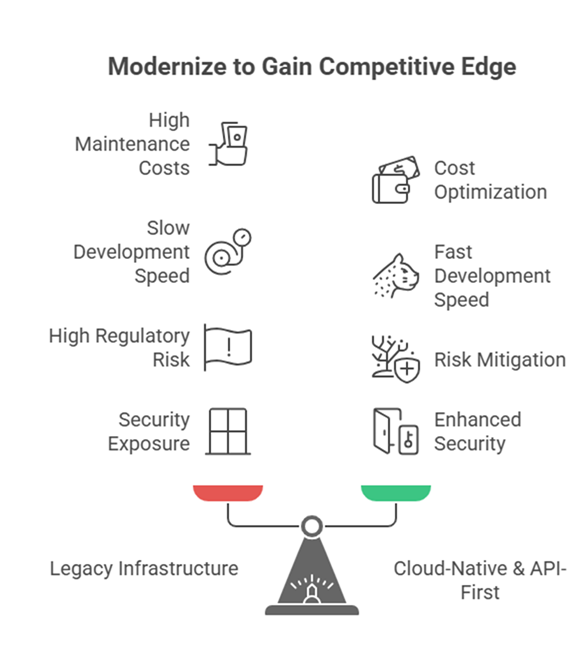
Cost burden: 80% of IT budgets on maintenance, only 20% on innovation.
Speed disadvantage: 18-month product development vs. 6-8 weeks for fintech
Risk amplification: 240% higher regulatory penalty rates from manual processes
Security exposure: Legacy systems suffer 5x more security incidents
Total Cost of Inaction: Delaying modernization creates compounding disadvantages that become increasingly expensive to overcome. Escalating maintenance costs occur as mainframe skills become scarce, with experienced COBOL developers commanding premium salaries while younger talent avoids legacy platforms entirely. Integration complexity multiplies exponentially as point-to-point connections create brittle architectures that resist change and innovation. Most critically, institutions miss $2.3 trillion in embedded finance revenue opportunities globally, while suffering 38% annual market share loss to digital-native competitors who operate with fundamentally lower cost structures and superior customer experiences.
Benefits of Cloud-Native & API-First Architectures for Progressive Modernization in Finance
Modern architectures deliver immediate competitive advantages:
Cost Optimization
40-60% reduction in infrastructure costs
70% decrease in manual operational tasks
50% reduction in regulatory compliance costs
Business Agilty
3-5x faster product development cycles
Real-time service delivery vs. batch processing
300% acceleration in fintech partnership integration
Risk Mitigation
99.99% uptime vs. 97% legacy performance
60% reduction in security breach risk
Automated regulatory compliance
00
Architectural Patterns Driving Progressive Modernization in Finance
Successful financial system modernization requires surgical precision to dismantle monolithic architectures while maintaining business continuity and regulatory compliance. The following patterns provide battle-tested approaches for systematically deconstructing legacy systems into agile, cloud-native components without the operational risks that have derailed 60% of major banking transformations.
The Strangler Fig Pattern: Incremental Migration
This approach constructs new cloud-native services around existing legacy systems, gradually assuming functionality while preserving business continuity. Unlike risky “big bang” migrations that can paralyze operations for months, the Strangler Fig pattern enables financial institutions to modernize incrementally while maintaining regulatory compliance and customer service levels. Each new service is thoroughly tested in parallel with legacy systems before assuming production responsibilities, creating multiple safety nets that have contributed to its 95% success rate in major financial transformations.
Implementation Phases:
Months 1-6: Customer-facing services (mobile apps, dashboards) .
Months 6-18: Core banking functions (payments, account management)
Months 18-36: Complete transformation with legacy decommissioning
Risk Mitigation Benefits:
Zero business disruption during transition.
Parallel processing enables instant rollback capability
95% success rate vs. 40% for “big bang” approaches
Microservices and Bounded Contexts in Progressive Modernization in Finance
Microservices align technology with business organization, enabling independent team innovation while reducing the coordination overhead that traditionally slows financial institutions. This architectural approach transforms large, interdependent development teams into smaller, autonomous units that can make technology decisions optimized for their specific business domain. The result is not just faster development, but higher quality solutions as teams develop deep expertise in their areas rather than maintaining superficial knowledge across broad, complex monolithic systems.
Banking Domain Separation:
Customer Management: Identity, KYC, onboarding
Account Services: Deposits, loans, credit products
Payment Processing: Domestic and international transfers
Risk Management: Fraud detection, credit scoring, compliance
Business Impact:
40% faster development through eliminated dependencies
60% improved system reliability via fault isolation
Independent technology choices optimized per domain
Event Sourcing and CQRS for Financial Data
Event sourcing provides immutable audit trails essential for financial services compliance and operational excellence. This approach treats every system change as an event that cannot be modified or deleted, creating a permanent record that satisfies the most stringent regulatory requirements while enabling advanced capabilities impossible with traditional database architectures. Unlike conventional systems that only store current state, event sourcing maintains the complete history of how that state was achieved, enabling powerful analytics, debugging capabilities, and regulatory reporting that can answer any historical question with complete accuracy.
Regulatory Compliance Benefits:
Complete auditability with permanent event records
Temporal queries for historical account states
Automated regulatory reporting generation
Transaction rollback with maintained audit trails
CQRS Performance Optimization:
Separate read/write models for optimal query performance
Independent scaling based on demand patterns
Real-time analytics and fraud detection capabilities
Business Impact:
50-70% reduction in audit preparation time
Real-time fraud detection reducing losses by 65%
Instant regulatory reporting vs. batch processing delays
Asynchronous Choreography vs. Orchestration
Financial institutions must strategically choose between choreographed and orchestrated approaches for different business processes, as this architectural decision directly impacts system flexibility, operational control, and regulatory compliance capabilities.
Choreography: Decentralized Event Processing:
Optimal for distributed processes requiring flexibility and resilience:
Use Cases: Fraud detection, customer notifications, compliance monitoring, partner integration.
Benefits: 40% faster processing, enhanced resilience, reduced service coupling.
Orchestration: Centralized Workflow Management:
Provides control for complex, multi-step business processes:
Use Cases: Loan origination, customer onboarding, regulatory reporting, account closure
Benefits: Complete process visibility, centralized error handling, human oversight integration
00
API Design and Management: The Backbone of Progressive Modernization in Finance
APIs enable internal innovation and external partnerships that drive revenue growth and competitive differentiation. Well-designed API strategies transform technology infrastructure from a cost center into a profit center, enabling financial institutions to monetize their core capabilities while building ecosystem partnerships that would have been impossible with legacy architectures. The most successful institutions view APIs not just as technical interfaces, but as product offerings that can generate substantial revenue streams while reducing the cost of customer acquisition through partner channels.
REST vs. GraphQL in Fintech
The choice between REST and GraphQL architectures determines both customer experience quality and partnership integration velocity, making this technical decision a critical factor in competitive positioning and revenue generation capabilities.
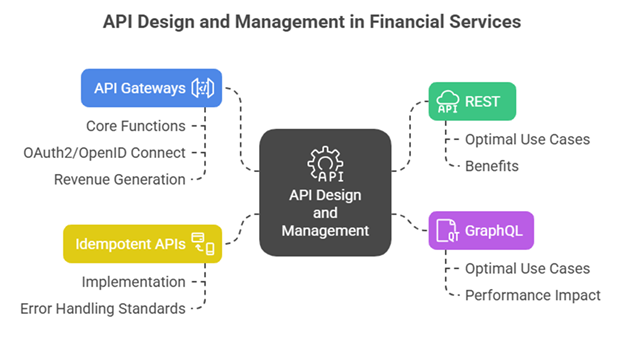
REST: Foundation for Financial APIs REST APIs provide the stability and predictability essential for financial services, with established patterns that regulators understand and partners can easily integrate. The maturity of REST tooling and developer expertise significantly reduces implementation risk and time-to-market for external-facing services.
Optimal Use Cases: External partner APIs requiring broad compatibility, high-volume transactions needing proven performance patterns, regulatory APIs demanding standardized interfaces, and legacy integration where established REST patterns minimize complexity.
Benefits: Industry-standard implementation reduces partner onboarding time by 40%, proven security patterns accelerate regulatory approval processes, and simplified caching architectures enable high-volume operations essential for payment processing.
GraphQL: Optimized Data Access GraphQL excels in scenarios requiring flexible data access and optimized performance, particularly for customer-facing applications where user experience directly impacts retention and satisfaction. Its ability to fetch precisely the required data in a single request eliminates the over-fetching problems that plague traditional REST APIs in complex financial dashboards.
GraphQL: Optimized Data Access GraphQL excels in scenarios requiring flexible data access and optimized performance, particularly for customer-facing applications where user experience directly impacts retention and satisfaction. Its ability to fetch precisely the required data in a single request eliminates the over-fetching problems that plague traditional REST APIs in complex financial dashboards.
Optimal Use Cases: Mobile banking applications where bandwidth and battery life matter, customer dashboards requiring complex data relationships from multiple sources, internal analytics needing flexible querying capabilities, and real-time customer 360° views across multiple business domains.
Performance Impact: 30-40% reduction in mobile data usage improves customer experience and reduces infrastructure costs, while 50-150ms response times vs. 200-400ms for complex REST queries translate to measurably higher customer engagement and satisfaction scores.
Idempotent APIs: Ensuring Transaction Integrity in Progressive Modernization in Finance
In financial services, network failures and system errors cannot result in duplicate transactions or inconsistent account states, making idempotent API design essential for maintaining customer trust, regulatory compliance, and operational integrity.
Critical for financial transaction integrity and regulatory compliance:
Implementation:
Idempotency keys prevent duplicate processing.
State validation ensures consistent account states
Complete audit trail of operations and retry attempts
Error Handling Standards:
HTTP 429 (Rate Limiting): Prevents system overload
HTTP 422 (Validation Error): Clear feedback for failures
HTTP 503 (Service Unavailable): Graceful degradation
Benefits:
Zero duplicate transactions during network failures
95% of temporary failures resolved automatically
40% reduction in customer service calls
AI Touchpoints Across Industries in the SDLC
Multi-dimensional Quality Metrics: AI generates individual scores for completeness, clarity, testability, and correctness.
Requirement Maturity Assessment: Tracks improvements or regressions in quality over time.
Predictive Quality Indicators: Highlights which requirements are most likely to introduce future defects.
API Gateways and Security (OAuth2, OpenID Connect)
API gateways serve as the foundation for secure digital business relationships, enabling financial institutions to confidently open their services to partners while maintaining centralized control over access, compliance, and revenue generation.
Centralized security and traffic management enables secure digital business relationships:
Core Functions:
Traffic management: Load balancing, rate limiting, request routing
Security enforcement: Authentication, authorization, threat protection
Policy implementation: Centralized governance and compliance
OAuth2/OpenID Connect:
Token-based authentication for partner integrations
Scope-based authorization for granular permissions
Federated identity across partner ecosystems
Revenue Generation:
Banking-as-a-Service: $50-500 monthly per enterprise client
Payment Processing: $0.10-$0.50 per transaction
Identity Verification: $2-5 per verification
00
Data Migration and Consistency Strategies
Data migration represents the highest-stakes component of financial system modernization, where a single error can result in regulatory violations, customer fund discrepancies, or complete business disruption. Modern migration strategies eliminate these traditional risks through real-time synchronization, automated validation, and parallel processing that maintains business continuity while enhancing data quality and regulatory compliance.
Change Data Capture (CDC) with Debezium
CDC enables zero-downtime transformation by maintaining parallel legacy and modern systems:
Benefits:
Real-time synchronization between systems
Complete audit trail for regulatory compliance
Instant rollback capability if issues arise
Risk-free validation with production data
Distributed Transactions and Saga Pattern
Maintains financial transaction integrity across microservices through compensating transactions:
Use Cases: Money transfers, loan origination, customer onboarding
Compliance Features:
Transaction atomicity across distributed services
Automatic compensation for failed processes
Comprehensive audit trails for all operations
Transaction atomicity across distributed services
Ensuring Data Integrity and Compliance During Migration
Data Protection:
Schema versioning for backward compatibility
Field-level encryption for sensitive data
Data masking for privacy protection
Tokenization for secure payment processing
Compliance Automation:
SOX: Automated audit trails and segregation of duties
PCI DSS: Comprehensive credit card data protection
GDPR: Privacy controls and data portability
Basel III: Enhanced risk data aggregation
00
Cloud-Native Deployment and Scalability
Cloud-native infrastructure transforms financial institutions from reactive cost centers into agile innovation engines capable of elastic scaling and operational resilience. This architectural shift enables institutions to automatically adjust capacity based on real demand rather than expensive over-provisioning, while achieving 40-60% cost reductions and 99.99% uptime that directly impacts customer satisfaction and competitive positioning. Modern deployment practices eliminate the traditional trade-off between stability and agility, enabling continuous innovation without operational risk.
Containerization (Kubernetes) and Serverless Functions
Kubernetes container orchestration provides automated management capabilities that transform IT operations from reactive firefighting to proactive optimization. The platform’s self-healing capabilities automatically detect and replace failed components faster than human operators could respond, while intelligent auto-scaling adjusts capacity based on actual demand patterns rather than static capacity planning that often leads to over-provisioning and waste.
Serverless Applications:
Document processing for loan applications
Real-time fraud detection
Regulatory report generation
API functions for authentication
Cost Impact:
40-60% reduction in infrastructure costs
70% decrease in manual operational overhead
Pay-per-use pricing for variable workloads
High Availability and Disaster Recovery Patterns
Financial institutions must architect for zero tolerance of service disruption, as each hour of downtime costs an average of $5.6 million in lost revenue while permanently damaging customer trust and regulatory confidence.
Multi-zone Architecture:
Active-active deployment across multiple data centers
Automatic failover without human intervention
Geographic distribution for disaster protection.
Business Impact:
99.99% uptime vs. 97% for legacy systems
$5.6M average hourly downtime cost elimination
Enhanced regulatory confidence in operational resilience.
Observability: Monitoring, Logging, and Tracing
Comprehensive system visibility transforms IT operations from reactive firefighting to proactive business optimization, enabling institutions to prevent 70% of customer-impacting incidents while generating real-time insights that drive strategic decision-making.
Monitoring Stack:
Prometheus + Grafana: Real-time alerting and dashboards
ELK/EFK Stack: Centralized logging and troubleshooting
OpenTelemetry: End-to-end transaction tracing
Benefits:
60-80% faster problem resolution
70% reduction in customer-impacting incidents
Data-driven optimization of business processes
00
Security and Compliance in Modern Architectures
Security in modern financial systems transcends traditional protection to become a strategic business enabler that accelerates partnerships, builds customer trust, and reduces operational risk while automating regulatory compliance. Advanced security architectures eliminate the historical trade-off between robust protection and rapid innovation, enabling institutions to move faster than competitors while maintaining superior security postures that attract partners and customers.
DevSecOps for Financial Services
Embedded security controls throughout development lifecycle transform security from constraint to competitive advantage by eliminating the traditional friction between security requirements and business velocity. This integration ensures that security enhancements accelerate rather than impede time-to-market, while automatically generating the documentation and compliance evidence that regulators require. The shift from manual security reviews to automated policy enforcement enables continuous deployment practices that would be impossible under traditional security models.
Automated Pipeline:
Static code analysis for pre-deployment vulnerability identification
Dynamic testing for runtime security validation
Dependency scanning for third-party library management
Infrastructure as code validation for policy enforcement
Business Impact:
80% reduction in security vulnerabilities
Accelerated time-to-market via eliminated manual reviews
50% faster incident response through automation
Regulatory Adherence (PCI DSS, GDPR)
Modern architectures transform regulatory compliance from expensive manual processes into automated competitive advantages that reduce costs by 50-70% while enabling rapid expansion into new markets and jurisdictions.
PCI DSS Automation:
Network segmentation through microservices architecture
Field-level encryption for card data protection
Automated access controls and monitoring
GDPR Controls:
Automated data discovery and classification
Granular consent tracking and enforcement
Automated data removal and portability
Benefits:
50-70% reduction in compliance costs
Real-time compliance monitoring vs. periodic audits
Automated documentation for regulatory examinations
Threat Modeling and Penetration Testing
Proactive security validation transforms cybersecurity from reactive expense into measurable business value through reduced insurance premiums, enhanced customer confidence, and regulatory advantages that accelerate partnerships and market expansion.
STRIDE Framework:
Spoofing: Multi-factor authentication and certificate verification
Tampering: Cryptographic signatures and immutable logs
Repudiation: Digital signatures and blockchain records
Information Disclosure: Data classification and encryption
Denial of Service: Auto-scaling and distributed resilience
Elevation of Privilege: Zero-trust and least-privilege access
Validation Programs:
Quarterly red team exercises testing defense effectiveness
Third-party penetration testing for independent assessment
Bug bounty programs for crowd-sourced vulnerability discovery
Business Value:
75% reduction in successful cyber attacks
20-30% reduction in cyber insurance premiums
Enhanced customer trust improving acquisition by 25%
00
Case Study: Achieving 300x Faster Reports and 99.99% Uptime
Technical Implementation Details
A $250B multinational bank transformed regulatory reporting infrastructure addressing Basel III requirements while maintaining full operational continuity. The institution chose a progressive modernization approach specifically to avoid the business disruption that had derailed similar initiatives at peer institutions, implementing parallel processing throughout the transition to eliminate risk while proving new system capabilities with production data.
Technology Stack:
Cloud Platform: AWS with multi-AZ deployment (EKS, S3, RDS Aurora, Lambda)
Event Streaming: Apache Kafka for real-time data processing
Data Sync: Debezium CDC for legacy integration
APIs: REST and GraphQL with OpenAPI documentation
Security: OAuth2, Keycloak, AWS WAF, IAM policies
DevOps: Jenkins CI/CD, Terraform IaC, GitOps with ArgoCD
Migration Approach:
Phase 1: Cloud infrastructure and CDC pipeline
Phase 2: Reporting service migration with parallel processing
Phase 3: Complete cutover with legacy decommissioning
Quantifiable Business Impact
Performance Results:
Report generation: 90 seconds vs. 6 hours (300x improvement)
System uptime: 99.99% vs. previous 97.2%
Data freshness: Real-time vs. daily batch updates
Financial Impact:
Infrastructure savings: $8.2M annual (45% reduction)
Operational efficiency: $15M annual through 70% automation
Risk mitigation: $2.3M eliminated regulatory penalties
New revenue: $25M annual from API-enabled data products
ROI Analysis:
Total investment: $12M over 18 months
Annual benefits: $50.5M
Payback period: 11 months
3-year ROI: 420%
00
Conclusion: A Roadmap for Future-Proof Financial Systems
Financial institutions that successfully execute comprehensive digital transformation will define the next decade of banking through superior operational efficiency, faster innovation cycles, and customer experiences that create sustainable competitive moats against both traditional and fintech competitors.
Implementation Framework
Financial Impact:
Focus: Customer-facing services, mobile applications
Investment: $2-5M for typical regional institution
ROI: 150-200% through improved customer experience
Risk: Low impact on core operations
Phase 2: Core Enhancement (Months 12-24)
Focus: Payment processing, account management, lending
Investment: $5-15M depending on complexity
ROI: 200-300% through operational efficiency
Risk: Medium with proven patterns
Phase 3: Advanced Capabilities (Months 24-36)
Focus: AI integration, real-time analytics, embedded finance
Investment: $3-10M for innovation capabilities
ROI: 300-500% through new business models
Risk: Medium with significant upside
Success Metrics
Financial KPIs:
40-60% infrastructure cost reduction within 18 months
20-30% digital service revenue growth within 24 months
50-70% operational process automation within 12 months
Operational KPIs:
99.9%+ uptime for customer-facing services
3-5x acceleration in product development cycles
25-40% improvement in customer satisfaction
Getting Started Framework
Immediate Actions (Next 90 Days):
Secure board commitment for multi-year transformation
Establish budget ($5-25M based on institution size)
Select cloud platform and implementation partners
Form dedicated transformation team
Foundation Building (Months 1-6):
Launch pilot project with customer-facing service
Implement team training program (15-20% of project cost)
Establish cloud infrastructure and security frameworks
The competitive window is narrowing as digital-native companies establish market dominance and early-adopting traditional institutions complete their transformations. Industry analysis indicates that institutions completing modernization within 24-36 months will secure market leadership positions through superior operational efficiency, faster innovation cycles, and enhanced customer experiences, while those delaying face structural disadvantages that become increasingly difficult and expensive to overcome.
Connect with V2Solutions to modernize your financial infrastructure with proven cloud-native strategies that deliver measurable ROI and competitive advantage.
00
Resources and Further Reading
Books
Cloud Native Architecture: Efficiently moving legacy applications and monoliths to microservices and Kubernetes by Fernando Harris
System Design Interview: An insider’s guide – 2 Volume Set (Full Colour Edition) by Alex Xu and Sahn Lam
Software Architecture: The Hard Parts: Modern Trade-Off Analyses for Distributed Architectures by Jacqueline G. Fortin
Reimagine Financial Systems for the Next Decade
Discover proven modernization strategies that accelerate innovation, strengthen resilience, and unlock measurable ROI.
Author’s Profile
