
Achieving 40% Faster Delivery:
The Business Case for
AI Accelerators in the SDLC
The business case for AI accelerators in the SDLC — how intelligent automation unlocks 40% faster software delivery, 30%+ cost savings, and sustainable innovation capacity across industries.
Executive Summary
In today’s digital landscape, software delivery speed is a key differentiator. Organizations that ship high-quality software 40% faster gain clear advantages—from quicker time-to-market to stronger customer satisfaction and revenue growth.
Traditional SDLC models, however, struggle to keep pace. Rising business demands, evolving customer expectations, and reliance on manual, repetitive tasks create bottlenecks that limit delivery velocity and hinder innovation—further underscoring the need for AI in SDLC to transform delivery performance.
00
Introduction: The Strategic Value of AI in SDLC
Modern customers demand instant gratification and continuous innovation. Expectations have intensified as tolerance for software issues drops and the need for rapid feature delivery continues to rise. Organizations that adopt AI in SDLC gain the agility to meet these evolving demands, sustain higher release quality, and avoid the customer attrition and competitive disadvantage faced by teams relying solely on traditional development practices.
Pressure to Innovate Amid Cost Constraints
Economic pressures have intensified the need for development efficiency. Organizations face the dual challenge of accelerating innovation while managing constrained budgets and limited technical talent. AI accelerators provide a path to achieve both objectives simultaneously by maximizing the productivity of existing resources.
Industry-Specific Demands
Financial Services: Regulatory compliance requirements demand rapid yet secure development cycles, with new regulations requiring implementation in increasingly compressed timeframes.
Healthcare: Patient safety and regulatory oversight create unique development challenges where speed cannot compromise quality or security.
Manufacturing: Industrial IoT and operational technology integration require specialized development approaches that traditional SDLC models struggle to support efficiently.
Hi-Tech: Competitive pressure demands continuous innovation cycles that push traditional development methodologies to their limits.
Media & Entertainment: Content delivery platforms require rapid iteration capabilities to respond to changing audience preferences and market trends.
Real Estate: Digital transformation initiatives require quick deployment of customer-facing technologies while maintaining operational stability.
00
Understanding AI Accelerators — AI in SDLC Explained
AI accelerators are intelligent software tools and platforms that leverage machine learning, natural language processing, and predictive analytics to automate and optimize various aspects of software development. Unlike traditional automation tools that follow predefined rules, AI accelerators learn from patterns, adapt to changing conditions, and make intelligent decisions based on historical data and contextual analysis.
Core Capabilities
Intelligent Code Generation: AI-powered coding assistants that understand context and generate high-quality code snippets.
Automated Testing: Smart test case generation and execution based on code analysis and user behavior patterns.
Predictive Analytics: Forecasting potential issues, bottlenecks, and optimization opportunities.
Intelligent Documentation: Automated generation and maintenance of technical documentation.
Resource Optimization: Dynamic allocation of development resources based on project requirements and team capabilities.
Common Use Cases Across the Lifecycle
Planning & Design Phase
AI accelerates early-stage decision-making by analyzing requirements, generating user stories, recommending optimal architectures, and identifying potential risks before development begins. This creates a clearer, more structured foundation and reduces costly redesigns later in the cycle.
Development Phase
During development, AI elevates productivity through intelligent code completion, automated code generation, continuous optimization suggestions, and proactive security scanning. It streamlines dependency management and reduces manual effort, enabling teams to move faster without compromising quality.
Testing Phase
AI strengthens the testing process by automatically creating test cases, prioritizing execution based on risk and impact, and identifying performance bottlenecks. This leads to faster test cycles, higher coverage, and more reliable releases.
Deployment Phase
In deployment, AI automates environment setup, fine-tunes pipelines, and configures monitoring and alerting systems. This ensures smoother rollouts, improved reliability, and faster recovery from issues, ultimately supporting continuous delivery at scale.
From Code Generation to Test Automation
The evolution from simple code completion to comprehensive AI-driven development represents a fundamental shift in how software is created. Modern AI accelerators understand context, maintain coding standards, and can generate entire functional modules based on high-level requirements. This progression enables development teams to focus on architecture, user experience, and business logic while AI handles implementation details.
00
Industry-Specific Applications and Impact of AI in SDLC
AI accelerators are not limited to a single industry or technology stack. Their impact is visible across regulated and unregulated sectors, from BFSI to Manufacturing to Real Estate.
BFSI: Compliance-Driven Development at Scale
The BFSI sector operates under stringent regulatory frameworks such as SOX, PCI-DSS, and GDPR, which demand security-first development and seamless integration with legacy systems. AI accelerators streamline these complexities by automating compliant code generation, predicting regulatory impacts on existing systems, and conducting continuous security testing. They also simplify legacy modernization by generating intelligent APIs that bridge old and new infrastructures. As a result, organizations experience significantly faster compliance-driven development cycles, fewer production vulnerabilities, and accelerated audit readiness—directly improving operational and regulatory outcomes.
Hi-Tech: Innovation Velocity and Competitive Edge
Hi-Tech companies face rapid innovation cycles, complex architectures, and relentless competitive pressure. AI accelerators enhance innovation velocity by optimizing code performance, predicting scalability requirements, and guiding feature rollouts based on user behavior insights. They also bring competitive intelligence directly into development planning, enabling teams to prioritize features aligned with market trends. These capabilities shorten development cycles, elevate system performance, and reduce post-release issues—driving a sharper competitive advantage.
Healthcare: Secure, Faster Rollouts with Clinical Accuracy
Healthcare software must align with HIPAA, medical device regulations, and safety-critical workflows. AI accelerators support clinical-grade development through automated validation against medical standards, privacy-preserving design patterns, and intelligent device integration. They also evaluate clinical algorithms to ensure accuracy and reliability. These capabilities enable faster deployment of healthcare applications, reduce compliance delays, and improve the success rate of clinical workflow integrations—ultimately supporting safer and more efficient patient outcomes..
Manufacturing: Accelerated IIoT and MES Integrations
Manufacturing environments rely on IIoT devices, MES platforms, and real-time operational systems that demand precision and reliability. AI accelerators simplify these integrations by automating device connectivity, harmonizing operational data, and generating predictive maintenance modules. They also support safety-critical development by embedding automated safety processes and validation. This leads to faster IIoT implementations, reduced integration complexities, and stronger reliability across manufacturing systems.
Media & Entertainment: Streamlining Content and UX Pipelines
The Media & Entertainment sector requires rapid content processing, seamless multi-platform delivery, and dynamic scalability during spikes in user demand. AI accelerators optimize the entire content pipeline—from intelligent content processing to automated A/B testing and real-time UX personalization. They also forecast traffic loads to ensure efficient scaling of delivery networks. These capabilities accelerate content delivery, enhance user engagement, and eliminate delays caused by manual scaling workflows.
Real Estate: Quicker CRM and Workflow Deployments
Real estate organizations manage complex workflows, large CRM systems, and multi-source property integrations while ensuring compliance across jurisdictions. AI accelerators support this landscape through intelligent workflow automation, smart CRM data harmonization, and integrated market analysis. They also monitor regulatory compliance continually, reducing the burden on development teams. This results in faster CRM deployments, more efficient property management workflows, and lower compliance-related development overhead.
AI Touchpoints Across Industries in the SDLC
Multi-dimensional Quality Metrics: AI generates individual scores for completeness, clarity, testability, and correctness.
Requirement Maturity Assessment: Tracks improvements or regressions in quality over time.
Predictive Quality Indicators: Highlights which requirements are most likely to introduce future defects.
00
Quantifying the 40% Delivery Advantage — Metrics for AI in SDLC
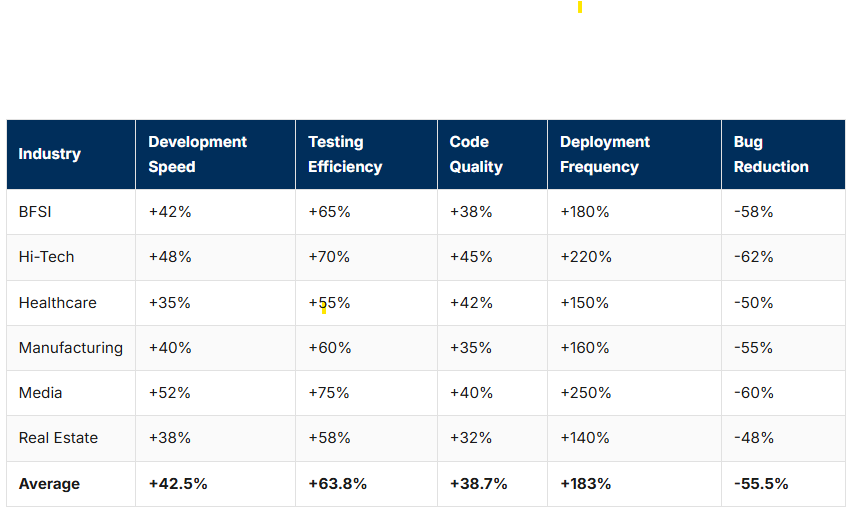
The implementation of AI accelerators creates measurable improvements across multiple delivery metrics. Organizations consistently report significant reductions in cycle times, defect rates, and resource requirements when AI tools are properly integrated into their development workflows.
Development Velocity Improvements
Code generation speed increases by 300–500%.
Testing cycle time reduces by 60–70%.
Deployment frequency increases by 200–300%.
Bug detection time decreases by 50–65%.
Cost Optimization and Resource Efficiency
AI accelerators deliver cost benefits through multiple vectors: reduced manual effort, improved resource utilization, decreased rework, and optimized infrastructure usage. The compound effect of these improvements often exceeds initial projections, with many organizations reporting total cost reductions of 25–35% within the first year of implementation.
Developer Productivity Gains: Key Performance Improvements by Industry
Productivity Multiplier Effects
Senior developers can focus 70% more time on architecture and innovation.
Junior developers achieve 300% faster learning curves with AI assistance.
Code review cycles accelerate by 80% with AI-powered analysis.
Documentation maintenance becomes 90% automated.
00
AI-Enhanced SDLC Architecture
The integration of AI accelerators requires a thoughtful architectural approach that considers existing toolchains, team workflows, and organizational processes. Successful implementations follow a layered integration strategy that gradually introduces AI capabilities while maintaining development stability and team productivity.
AI Integration Layers
Foundation Layer: Core AI services and machine learning platforms.
Orchestration Layer: Workflow automation and process intelligence.
Continuous Monitoring and Retraining: Managing model drift and ensuring ongoing performance and fairness as data patterns evolve.
Auditability and Reproducibility: The ability to recreate an AI model’s decision-making process at any point in time for audit purposes.
Security of AI Pipelines: Protecting AI models and data from malicious attacks and unauthorized access throughout their lifecycle.
Critical Integration Points
Version control systems with AI-powered code analysis.
CI/CD pipelines enhanced with intelligent testing and deployment.
Issue tracking systems with predictive analytics.
Communication platforms integrated with development intelligence.
Integration Success Factors
API-First Approach: Ensuring all AI services provide robust APIs for tool integration.
Data Pipeline Architecture: Establishing reliable data flows for AI model training and inference.
Security Integration: Implementing AI security scanning and compliance checking throughout the pipeline.
Feedback Loops: Creating mechanisms for continuous AI model improvement based on development outcomes.
00
Risks and Considerations
AI accelerators, while powerful, introduce new categories of risk that organizations must actively manage. AI bias can manifest in code generation, testing strategies, and deployment decisions, potentially creating systemic issues that affect product quality and user experience.
Bias Mitigation Strategies
Diverse Training Data: Ensuring AI models are trained on diverse codebases and use cases.
Regular Model Auditing: Implementing systematic reviews of AI decision-making patterns.
Human Oversight Integration: Maintaining human review points for critical AI-generated decisions.
Bias Detection Tools: Deploying specialized tools to identify and correct AI bias in development processes.
Governance and Security Concerns
The integration of AI into the SDLC creates new attack vectors and governance challenges. Organizations must establish comprehensive frameworks for AI governance that address data privacy, intellectual property protection, and regulatory compliance.
Security Considerations.
Code Intellectual Property: Protecting proprietary code patterns from AI model exposure.
Data Privacy: Ensuring AI tools don’t inadvertently expose sensitive customer or business data.
Supply Chain Security: Validating the security of AI tool providers and their data handling practices.
Audit Trail Maintenance: Establishing comprehensive logging and audit capabilities for AI-assisted development.
Human Oversight in Automated Processes
The most successful AI accelerator implementations maintain strategic human oversight while maximizing automation benefits. This requires careful balance between efficiency gains and quality control, with clear escalation paths for complex decisions that require human judgment.
Oversight Framework Elements
Decision Boundary Definition: Clearly defining which decisions AI can make autonomously.
Review Threshold Settings: Establishing criteria that trigger human review requirements.
Escalation Procedures: Creating clear paths for complex issues that exceed AI capabilities.
Continuous Learning Integration: Using human feedback to improve AI decision-making over time.
00
Building the Business Case
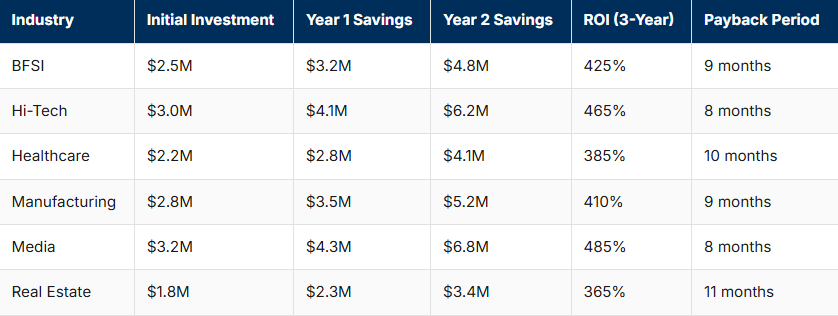
The business case for AI accelerators must consider both direct cost savings and strategic value creation. Most organizations achieve positive ROI within 6–12 months of implementation, with cumulative benefits accelerating significantly in years two and three.
ROI Calculation Framework
The ROI of AI accelerators can be measured through a structured framework that captures both direct cost savings and long-term strategic value. Direct savings emerge from reduced development time, lower testing effort, optimized infrastructure usage, and fewer maintenance issues due to higher-quality code. Beyond operational efficiency, AI accelerators also create strategic advantages by accelerating time-to-market, strengthening competitive positioning, elevating customer satisfaction, and expanding overall development capacity for innovation. To fully realize these benefits, AI initiatives must remain tightly aligned with broader business objectives around transformation, growth, and efficiency. When organizations anchor AI adoption to clearly defined outcomes, they achieve faster internal buy-in and more tangible, measurable ROI.
ROI Snapshot by Industry Sector
Value Creation Multipliers
Market Responsiveness: 40% faster response to market opportunities.
Innovation Capacity: 60% increase in experimental project capacity.
Quality Improvements: 55% reduction in customer-reported issues.
Team Satisfaction: 45% improvement in developer satisfaction scores.
Strategic Alignment Factors
Digital transformation acceleration.
Operational efficiency optimization.
Innovation capability enhancement.
Competitive advantage development.
Risk mitigation and compliance improvement.
00
Implementation Roadmap
A structured, phased roadmap ensures AI accelerators are adopted in a controlled, measurable, and scalable manner.
Assessment and Opportunity Identification
The implementation journey begins with a structured assessment phase designed to establish clarity on the current development landscape. During Weeks 1–4, organizations conduct a thorough audit of existing development processes to uncover bottlenecks, evaluate the tool chain for integration potential, and assess team capabilities to determine training requirements. This stage also includes establishing ROI baselines and defining clear success metrics to guide the program.
From Weeks 5–8, the focus shifts to AI readiness evaluation. This involves reviewing the quality and accessibility of organizational data, assessing infrastructure scalability and security posture, and understanding the organization’s readiness for change. Vendors and technologies are evaluated to ensure the selected AI accelerators align with long-term strategic goals.
Pilot Program and Tooling Recommendations
The pilot program serves as a controlled environment to validate the feasibility and value of AI accelerators. Between Weeks 9–20, organizations select a limited-scope project and deploy the chosen AI tools within a confined development workflow. During this stage, teams undergo targeted training, workflows are integrated with AI capabilities, and initial performance metrics are collected to measure early impact. Ideally, the pilot involves a single development team working on a non-critical feature or application over a two-to-three-month cycle, supported by a comprehensive metrics framework.
In Weeks 21–24, the pilot undergoes a structured evaluation. This includes analyzing performance outcomes, calculating ROI, and refining processes based on lessons learned. Best practices are documented, and a scaling plan is formalized to guide the broader rollout across the organization.
Scaling Across Teams and Pipelines
Months 7–12 mark the beginning of gradual scaling, where additional teams are onboarded using a staggered approach. Advanced AI features are enabled progressively, and cross-team collaboration mechanisms are established to ensure knowledge transfer. Continuous improvement loops are introduced to maintain consistency, quality, and productivity as adoption expands.
By Months 13–18, the organization reaches full-scale deployment. AI accelerators are implemented across all development teams and pipelines, supported by advanced analytics and optimization practices. At this stage, enterprises initiate strategic innovation projects powered by AI and begin measuring long-term value realization and ROI at an enterprise level.
Critical Success Factors
Successful implementation relies on sustained support from leadership and a well-managed change strategy. Comprehensive training programs ensure teams gain the necessary skills to integrate AI into their daily workflows. Iterative implementation cycles, reinforced by continuous feedback, keep the program aligned with evolving business needs. Lastly, a strong metrics framework provides the visibility required to monitor progress, validate impact, and guide ongoing optimization.
00
Case Snapshots and KPIs Tracked
While AI-based tools offer powerful capabilities, their effectiveness depends on how organizations adopt, govern, and evolve their use. Establishing best practices ensures consistent value realization and continuous improvement.
Case Study 1: Major Investment Bank – Trading Platform Modernization
Challenge: Legacy trading system modernization requiring 99.9% uptime during transition with complex regulatory compliance requirements.
AI Implementation: Automated code generation for API compatibility layers; AI-powered regression testing for critical trading functions; intelligent deployment orchestration with automatic rollback capabilities.
Results: 45% reduction in development timeline (18 months to 10 months); zero critical incidents during production deployment; $12M cost savings through accelerated time-to-market.
Case Study 2: Healthcare Technology Company – EMR Integration Platform
Challenge: Integration platform development for connecting disparate Electronic Medical Record systems while maintaining HIPAA compliance.
AI Implementation: AI-generated data mapping and transformation logic; automated HIPAA compliance checking throughout development; intelligent testing of medical data workflows.
Results: 50% faster integration development cycles; 100% HIPAA compliance achievement in first audit; 35% reduction in integration maintenance overhead.
Key Performance Indicators Across Case Studies
Development Velocity Metrics
Story completion rate improvement: +45% average.
Code review cycle time reduction: -65% average.
Deployment frequency increase: +180% average.
Quality Metrics
Production defect rate reduction: -55% average.
Security vulnerability reduction: -70% average.
Customer satisfaction improvement: +35% average.
Business Impact Metrics
Time-to-market acceleration: +40% average.
Development cost reduction: -30% average.
Revenue impact acceleration: +25% average.
Critical Success Lessons
Start Small, Scale Systematically: Successful implementations begin with focused pilots and expand gradually.
Invest in Training: Team capability development is crucial for maximizing AI accelerator benefits.
Maintain Human Oversight: The most successful implementations balance automation with strategic human decision-making.
Focus on Integration: AI accelerators deliver maximum value when seamlessly integrated into existing workflows.
Measure Continuously: Comprehensive metrics collection enables optimization and demonstrates value.
00
Why Now Is the Time to Act on AI in Software Delivery
Organizations that adopt AI accelerators in their SDLC establish long-term, compounding advantages by building the capabilities, processes, and culture required to continually integrate emerging AI innovations. Over time, they gain adaptive strength to absorb new technologies quickly, cultivate teams that collaborate effectively with AI to elevate creativity and efficiency, and maintain continuous optimization through AI-driven feedback loops. This sustained improvement accelerates innovation by increasing development velocity and enabling more experimentation. Ensuring long-term excellence requires a structured sustainability framework—regular model updates and capability enhancements, ongoing process refinement based on performance insights, continuous skill development across teams, and alignment of the broader technology roadmap with evolving AI advancements.
V2Solutions enables forward-thinking enterprises to modernize their SDLC with intelligent, scalable AI accelerators — connect with us to get started.
00
Resources and Further Reading
Books
Accelerate: The Science of Lean Software and DevOps: Building and Scaling High-Performing Technology Organizations by Nicole Forsgren, Jez Humble, and Gene Kim
The AI-Enabled SDLC: A Tech Leader’s Guide to Navigating the Future of Software Development by Brent Laster and Eran Yahav
Unlocking the AI-Powered SDLC: A Practical Guide for Software Engineers by Jacqueline G. Fortin
Ready to Accelerate Your SDLC by 40%?
Let’s explore how V2Solutions can help you embed AI accelerators across your SDLC to deliver faster, smarter, and more cost-efficient software.
Author’s Profile
